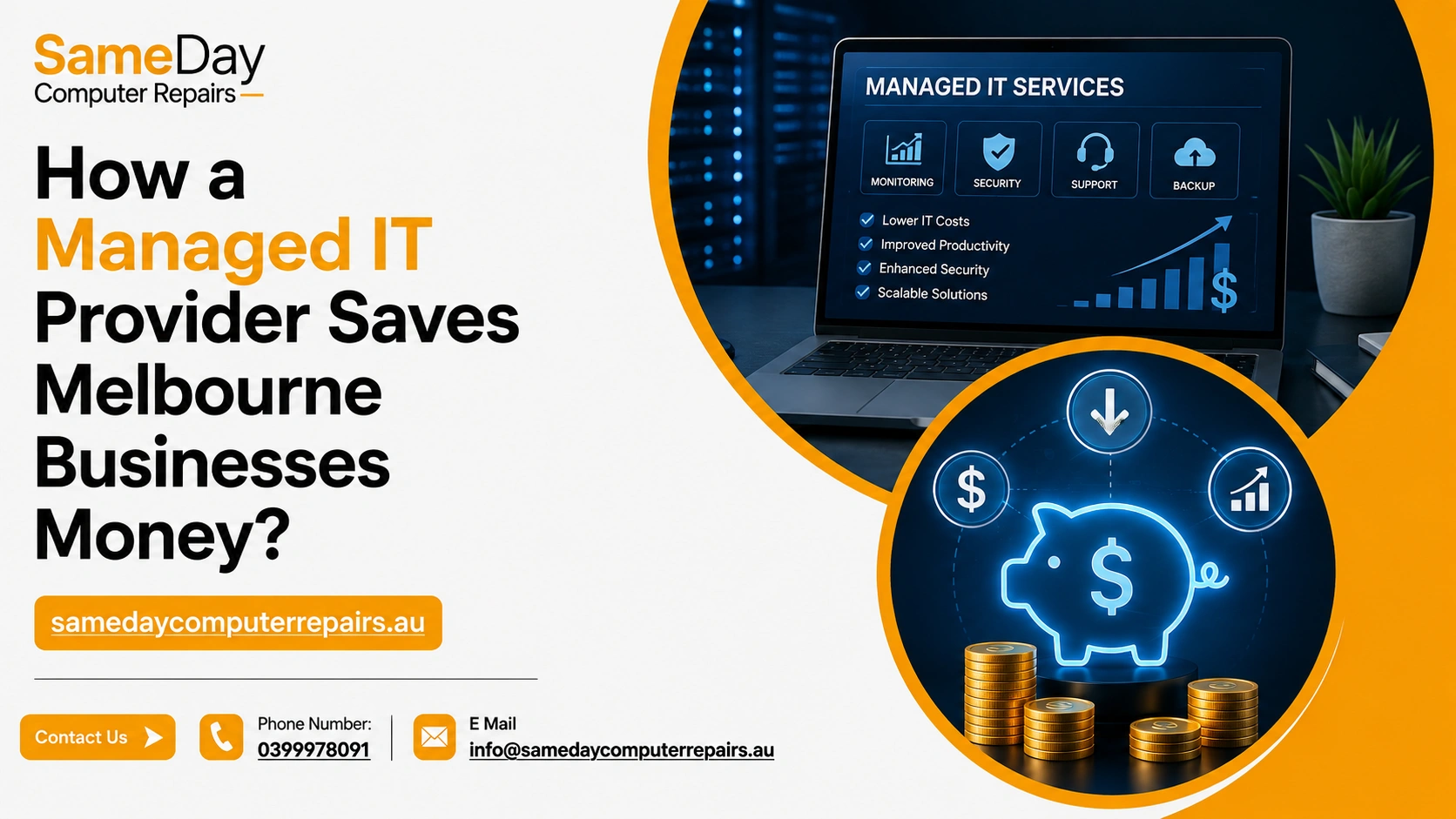
Most Melbourne businesses don’t think about IT until something breaks — a server goes down, a laptop won’t boot, or an email account gets compromised. By that point, the cost is already locked in: lost productivity, emergency call-out fees, and sometimes real reputational damage. A managed IT provider flips that model, replacing reactive firefighting with ongoing oversight — and the savings show up in places most business owners don’t expect.
The Real Cost of “Break-Fix” IT
If you’re only calling someone when something’s already broken, you’re paying for IT the most expensive way possible. Break-fix support tends to cost more in the long run because problems are only ever addressed after they’ve already caused disruption. It typically means:
- Unpredictable costs — a bad month can mean thousands in emergency repairs, with no way to budget for it in advance
- Downtime while you wait — every hour a system is down is an hour your team can’t work, invoice, or serve customers
- No prevention — issues get fixed once they’ve already caused damage, not before, so small faults are allowed to turn into major failures
- Higher hourly rates — urgent, same-day call-outs almost always cost more per hour than scheduled, proactive work
- Knowledge gaps — a different technician each time means re-explaining your setup and re-diagnosing issues that a consistent provider would already understand
A managed model replaces this with a flat, predictable monthly cost and — more importantly — ongoing monitoring that catches problems before they become expensive ones. The shift isn’t just about convenience; it changes where the money in your IT budget actually goes, from emergency labour and lost hours to prevention and planning.
Where the Savings Actually Come From?
1. Preventing Downtime Before It Happens
Our managed IT services include continuous monitoring of your systems, so failing hardware, storage running low, or a struggling server gets flagged and fixed before it takes your business offline. Downtime is one of the most underestimated costs a small business carries. It’s rarely just the hours lost — it’s staff sitting idle on the payroll, missed customer calls, delayed invoicing, and in some cases lost sales that never come back. A few hours without email or point-of-sale access can easily outweigh a year of a managed IT contract, which is why prevention tends to pay for the service on its own.
2. Fewer Emergency Call-Outs
Reactive IT support almost always costs more per hour than a managed plan, precisely because it’s urgent — technicians charge a premium for after-hours or same-day work, and you have no leverage to negotiate when a system is already down. With ongoing small business IT support, routine maintenance, software updates, and troubleshooting happen on a schedule rather than as a fire drill. Patches get applied before they become vulnerabilities, ageing hardware gets flagged before it fails, and small glitches get resolved before they escalate — which means far fewer of those expensive after-hours call-outs in the first place.
3. Avoiding the Cost of a Cyber Incident
A single ransomware attack or data breach can cost a small business tens of thousands of dollars once you account for recovery, downtime, lost customer trust, and in some cases regulatory or notification obligations. For many small businesses, one serious breach is enough to threaten the business itself. Our cyber security services build protection into your monthly plan instead of leaving it as a gamble — covering endpoint protection, patch management, email filtering, and monitoring that’s designed to prevent the incident in the first place rather than clean up after it. Prevention here is dramatically cheaper than recovery, almost every time.
4. Right-Sized Technology, Not Guesswork
Businesses frequently overspend on hardware, software licences, or cloud subscriptions they don’t fully use, or underspend and pay for it later in inefficiency, staff frustration, and workarounds. Through IT consulting, we help map your technology spend to what your business actually needs — reviewing what you’re paying for, what’s sitting idle, and where a cheaper or more efficient option would do the same job. That avoids both the wasted licence fees and the false economy of cutting corners on infrastructure that actually matters to how your team works.
5. Remote Fixes Instead of On-Site Visits
Not every issue needs someone driving out to your office, and travel time is one of the quieter costs baked into traditional IT support. With remote IT support, a large share of day-to-day issues — software conflicts, slow systems, printer errors, account access problems — get diagnosed and resolved without the cost, or the wait, of an on-site visit. That keeps both the bill and the downtime lower, and means most issues can be sorted the same hour they’re reported rather than the same day.
6. Fewer Costly Mistakes from Untrained Staff
A meaningful share of IT costs come from avoidable human error — a phishing email that gets clicked, a backup that was never actually tested, software installed outside of company policy that introduces a vulnerability. Ongoing support isn’t just about fixing machines; it’s also about closing these gaps through sensible policies, monitored backups, and access controls, so the business isn’t relying on luck to avoid an expensive mistake.
A Predictable Line Item, Not a Surprise Expense
Perhaps the biggest financial benefit is the simplest one: managed IT turns an unpredictable cost centre into a fixed monthly line item you can actually budget for. No guessing whether this quarter is the one where the server finally dies, or whether next month brings an unplanned $3,000 repair bill. That predictability makes it easier for Melbourne small businesses to plan spending, forecast growth, and avoid the cash-flow shock that comes with a major IT failure — which, for many small businesses, is reason enough on its own.
Is It Worth It for a Small Business?
Managed IT isn’t just for large enterprises. In fact, small businesses often benefit the most, since a single bad outage or breach represents a much bigger share of their revenue and reputation than it would for a larger company with deeper reserves. If your business runs on a handful of computers, a shared drive, and email that absolutely cannot go down, a managed plan is usually cheaper than the cost of even one serious incident — and it removes the constant low-level stress of not knowing whether your systems are actually being looked after.
Conclusion
If you’re tired of paying for IT problems after they’ve already cost you money, it’s worth having a conversation about what a managed plan would look like for your business. At Same Day Computer Repairs, we work with Melbourne businesses to build a support plan around what you actually run, not a one-size-fits-all package. Get in touch, and we’ll walk you through what’s covered and what it would realistically save you.




 Get Your FREE Diagnostic Check & Fast Repair Today!